Generative AI in simple terms
Microsoft’s AI 101 materials describe the core idea clearly: while many traditional AI systems analyze data to spot patterns or make predictions, generative AI creates new data. It studies the structure of training data (for example, how sentences flow, how pixels form objects, or how functions are written in a programming language) and then generates outputs that resemble that structure when you give it a prompt.
That does not mean the system “understands” the world the way people do. It means it has learned statistical relationships that let it continue or compose something plausible in response to your input.
How generative AI works (without the math)
-
Training: Models learn from large collections of examples (text, images, code, and more). Microsoft’s AI 101 overview cites common families such as transformers (typical for language models), GANs (generator vs. discriminator), and VAEs (compressed representations and variations).
-
Prompting: You supply instructions or context: a question, a brief, partial code, or an image to extend.
-
Generation: The model predicts what comes next (tokens, frames or patches, code lines) and assembles an output.
-
Policies and review: Many products add filtering, ranking, or extra training for safety and quality; implementation differs by vendor.
If you want a broader map of how AI fits together (machine learning, narrow AI, and more), see our hub article on what artificial intelligence is.
Text generation: real example – ChatGPT
What it is: A conversational assistant built on large language models that generates and edits text from natural-language prompts: answers, summaries, drafts, tables, step-by-step explanations, and more.
Real example: ChatGPT (OpenAI) is a widely used product in this category. You might prompt: “Explain compound interest to a teenager in 120 words,” and the model returns new wording for that request. The same tool can change tone, translate, or outline content – composed for your prompt, not copied from a single stored paragraph (some deployments also retrieve live documents).
Why this illustrates generative AI: The primary output is novel text conditioned on your instructions, which matches the “create new data” definition above.
Image generation: real example – DALL-E
What it is: Text-to-image models turn a written description into a new image that did not exist before in that exact form.
Real example: DALL-E is OpenAI’s image generation line, available in ChatGPT for eligible users and via OpenAI APIs. Prompt: “A watercolor of a red bicycle leaning against a café in the rain” yields a synthesized image matching your description.
Why this illustrates generative AI: The bitmap is produced for your prompt, not a fixed stock file. Quality and guardrails depend on model version and settings.
Video generation: real example – Sora
What it is: Text-to-video (and related inputs such as images) systems generate short video clips with motion, camera feel, and often synchronized audio, from prompts.
Real example: Sora is OpenAI’s video product line. Its public pages describe starting from a text prompt or an uploaded image to create clips in varied styles, plus features like remixing. Availability and pricing change – confirm on OpenAI before relying on it in production.
Why this illustrates generative AI: Video is a time-based medium; these systems generate new frames and motion rather than playing back a single pre-recorded clip tied 1:1 to your prompt.
Code generation: real example – GitHub Copilot
What it is: Code completion and synthesis inside a developer’s editor. The model reads your surrounding code and comments and suggests new lines, blocks, or edits.
Real example: GitHub Copilot (documented in GitHub’s official docs and engineering blog) sends contextual information from your IDE to a large model trained on public code patterns. Suggestions appear as ghost text you can accept, tweak, or reject. GitHub describes the flow at a high level: context near the cursor is combined with other signals, the model proposes completions, and the IDE formats them for review.
Why this illustrates generative AI: The assistant is authoring new source code conditioned on your project, not merely searching for an identical snippet in a single file (though similarity to public code raises license and review responsibilities for teams).
Limitations every beginner should know
Generative AI is powerful and easy to demo, but it is not an oracle.
-
HallucinationsModels can state false facts or invent citations confidently. Always verify important claims, especially in medical, legal, or financial contexts.
-
Bias and safetyTraining data reflects the web and other corpora; outputs can mirror stereotypes or produce content that violates policies. Products add guardrails, but they are imperfect.
-
Copyright and confidentialityGenerated text, images, or code may resemble existing works. Enterprises often set policies on what may be pasted into cloud tools. When in doubt, use org-approved accounts and data-handling rules.
-
Evaluation“Sounds good” is not the same as “correct.” For code, run tests and review for security issues; for customer-facing copy, fact-check and edit for brand voice.
How generative AI relates to conversational AI
Conversational AI (chatbots, voice agents) is often powered by generative models, but the term emphasizes dialogue and task flow rather than any single medium. If you want that split spelled out, read our guide to conversational AI next.
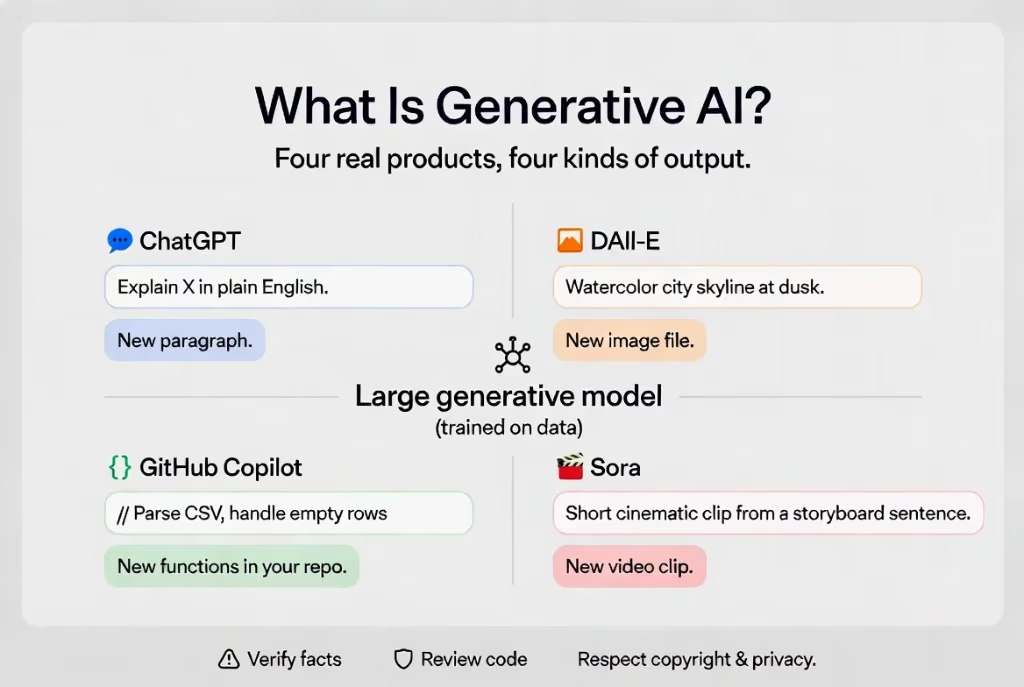
Infographic concept: “Four Faces of Generative AI”
Purpose: A single scroll-stopping visual for social and blog headers that maps input → model → output for four modalities.
Layout (landscape, 16:9 or 1200×630):
- Title bar: “What Is Generative AI?” Subhead: “Four real products, four kinds of output.”
- Center: A simple hub icon labeled “Large generative model (trained on data).”
- Four quadrants (clockwise from top-left):
- Text – Icon: speech bubble. Product label: ChatGPT. Prompt snippet: “Explain X in plain English.” Output chip: “New paragraph.”
- Image – Icon: picture frame. Product label: DALL-E. Prompt snippet: “Watercolor city skyline at dusk.” Output chip: “New image file.”
- Video – Icon: clapperboard. Product label: Sora. Prompt snippet: “Short cinematic clip from a storyboard sentence.” Output chip: “New video clip.”
- Code – Icon: terminal brackets. Product label: GitHub Copilot. Prompt snippet:
// Parse CSV, handle empty rows. Output chip: “New functions in your repo.”
- Footer strip: Three caution icons with one line each: “Verify facts,” “Review code,” “Respect copyright & privacy.”
Design note: Use distinct colors per quadrant but one shared typeface; keep product names spelled as trademarks belong to their owners.
Frequently asked questions
What is generative AI in one sentence?
Generative AI is a type of artificial intelligence that creates new content (such as text, images, video, or code) by learning patterns from data and responding to prompts.
Is ChatGPT generative AI?
Yes. ChatGPT is a text-focused generative AI product built on large language models.
How is generative AI different from predictive AI?
Predictive systems emphasize classification and forecasting (“Is this spam?” “Will churn happen?”). Generative systems emphasize synthesis (“Write a summary,” “Draw a logo sketch,” “Draft a function”).
Can generative AI replace human experts?
Not reliably for high-stakes work without oversight. It can accelerate drafting and exploration, but humans should verify accuracy, compliance, and quality.
Do I need to code to use generative AI?
No. Consumer tools provide chat and media interfaces; developers can also call APIs for deeper integration.
Sources and further reading
- Microsoft, “What is generative AI?” – AI 101 overview: microsoft.com/en/ai/ai-101/what-is-generative-ai
- OpenAI, ChatGPT: openai.com/chatgpt
- OpenAI, image generation documentation: platform.openai.com/docs/guides/images
- OpenAI, Sora: openai.com/sora
- GitHub Docs, GitHub Copilot code suggestions: docs.github.com/en/copilot/concepts/completions/code-suggestions
- GitHub Blog, “How AI code generation works”: github.blog/ai-and-ml/generative-ai/how-ai-code-generation-works