Where things stand right now
Elon Musk is simultaneously one of the most important people in the history of AI and one of its most disruptive current actors. He co-founded OpenAI in 2015, left acrimoniously in 2018, launched a competing AI company (xAI) in 2023, sued OpenAI in 2024, made an unsolicited $97.4 billion bid to acquire the organization in February 2025, had the bid rejected within days, and watched as a federal judge put key parts of his lawsuit on a trial track for 2026.
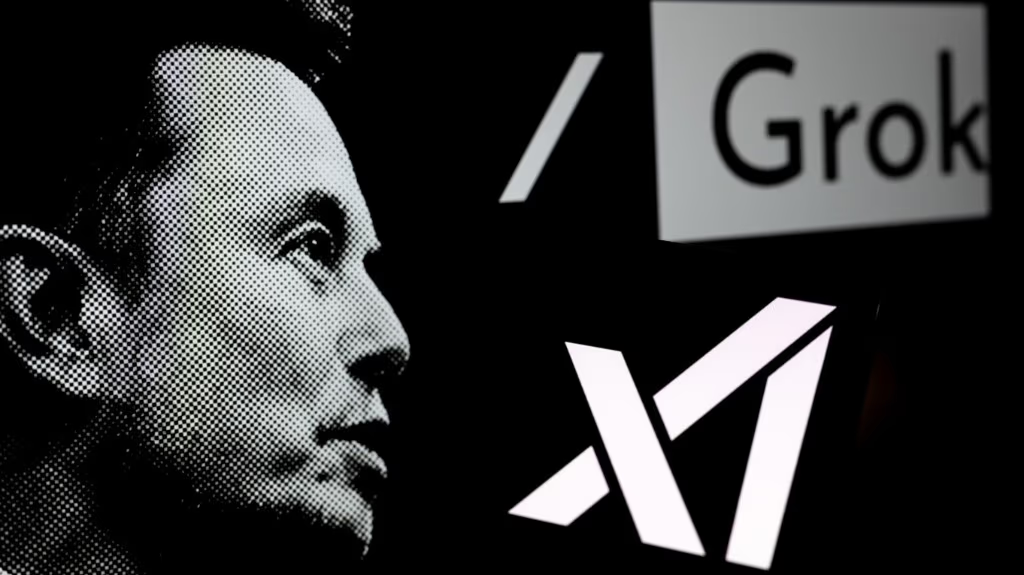
Meanwhile, xAI has raised over $12 billion, built what it calls the world’s most powerful AI training cluster in Memphis, shipped multiple generations of a chatbot called Grok, acquired X (formerly Twitter) in an all-stock deal, and ultimately merged with SpaceX in a transaction valued at $1.25 trillion as of February 2026.
The Musk-AI story has everything: a founding myth, a messy breakup, leaked emails, a courtroom fight, and a rival product. Here is the full account, fact by fact.
How Musk helped start OpenAI
In December 2015, a group of researchers and technology figures announced the launch of OpenAI as a nonprofit AI research company. The stated mission: advance digital intelligence in the way most likely to benefit humanity as a whole, “unconstrained by a need to generate financial return.” The founding post named Elon Musk and Sam Altman as co-chairs.
At the time, the framing made sense. The worry in 2015 was that advanced AI would be developed inside a handful of large corporations – primarily Google – with no accountability to the public. The idea was a counterweight: a nonprofit that published research openly and kept safety as a primary objective.
Musk was one of the most prominent names attached to the project. His involvement gave it visibility, credibility, and funding. A November 2015 email later released in the lawsuit showed Musk pushing hard on ambition: he told Sam Altman the company needed to raise at least $1 billion to be taken seriously. Musk promised to cover whatever was not raised by others. According to OpenAI’s own account, he ultimately committed approximately $45 million while other donors collectively contributed over $90 million.
The organization attracted serious researchers. It was, for a few years, what its founders said it would be: an open research lab working on frontier AI problems with public benefit as a stated goal.
Why he left – and what the emails show
The official story from February 2018 was clean: Musk left the OpenAI board to avoid a conflict of interest with Tesla, which was building AI for autonomous driving. The real story – as revealed by emails OpenAI published in March 2024, in response to Musk’s lawsuit – is considerably more complicated.
The control dispute
In late 2017, as it became clear that training advanced AI models would require billions of dollars rather than tens of millions, OpenAI began planning a for-profit subsidiary to raise capital. Musk’s position during these discussions, according to documents in the lawsuit record, was that he wanted majority equity, initial board control, and to serve as CEO. The rest of the board declined. Musk then proposed a different solution: merge OpenAI into Tesla, which he described as its “cash cow” and “the only path forward.” The board declined that too.
Musk left in February 2018. According to OpenAI’s account, when he departed he told the team he believed their probability of successfully building AGI was essentially zero and that he planned to build an AGI competitor himself – at Tesla.
What the emails actually say
The emails are important because Musk’s later lawsuit rests heavily on the argument that OpenAI betrayed a founding mission of openness and nonprofit orientation. OpenAI’s published emails show that Musk himself, in September 2017, had proposed creating a for-profit entity as the future structure for OpenAI – before the current leadership moved in that direction. The same emails show Musk supporting the idea that the organization should “start being less open” over time and not share its science publicly.
This does not resolve the legal dispute, which has specific contractual and fiduciary dimensions. But it complicates the narrative of Musk as a pure defender of the original nonprofit mission.
xAI: building the competitor
On March 9, 2023, Musk incorporated xAI – an AI company with an explicit mission to “understand the true nature of the universe” (a formulation deliberately contrasted with more corporate AI mission statements). He assembled a founding team of 11 AI researchers, several with backgrounds at Google DeepMind and other frontier labs.
The fundraising was rapid. xAI raised $500 million in a Series A in November 2023 at a $4 billion valuation, then $6 billion in a Series B in May 2024 at $24 billion, then another $6 billion in a Series C in December 2024 at $50 billion. Total raised: over $12 billion across roughly 14 months. Investors include Andreessen Horowitz, Sequoia Capital, BlackRock, Fidelity, NVIDIA, and AMD.
The speed of xAI’s capitalization reflects the broader AI investment environment of 2023-2024, but also Musk’s specific advantages: name recognition, an existing network of large investors, and ownership of X (formerly Twitter), which sits on a vast dataset of real-time human text – valuable training data for language models.
The X connection
Musk acquired Twitter in October 2022 for $44 billion and renamed it X. When xAI launched in 2023, X’s data became one of xAI’s key assets: Grok, xAI’s chatbot, has native real-time access to the X platform, giving it a live feed of public posts that other models do not have built-in. In March 2025, xAI formalized this relationship by acquiring X outright in an all-stock deal that valued X at $33 billion and xAI at $80 billion at the time of the deal.
Colossus: the supercomputer in Memphis
One of xAI’s most striking moves was building its own AI training infrastructure from scratch at a scale that competed directly with what OpenAI, Google, and Microsoft had taken years to construct.
In 2024, xAI repurposed a former Electrolux appliance factory in South Memphis, Tennessee – a 785,000 square foot facility – and built Project Colossus, a supercomputer configured with 100,000 NVIDIA H100 GPUs on a single RDMA fabric. The project went from conception to operational in 122 days. Within 19 days of the project’s conception, construction had begun.
xAI has described Colossus as the most powerful AI training system in the world at the time of its completion. The facility requires between 42 and 56 megawatts of power, with plans for up to 150 megawatts ultimately. By December 2024, xAI announced plans to expand Colossus to at least one million GPUs. The construction partners were Dell Technologies and Supermicro.
The Memphis location was chosen partly for its existing power infrastructure – Memphis Light, Gas, and Water and the Tennessee Valley Authority – and partly because a nearby wastewater treatment facility could supply cooling water. The repurposed factory model also saved months of construction time versus building a new facility.
Grok: what it is and how it compares
Grok is xAI’s generative AI chatbot and the public face of Musk’s AI ambitions. It has gone through multiple major versions since its initial release – Grok 1 (November 2023), Grok 1.5, Grok 2, Grok 3 (February 2025), and Grok 4 – with each generation representing a significant increase in training compute. Grok 3 was reportedly trained on 200,000 NVIDIA H100 GPUs, double the scale used for Grok 2.
What makes it distinctive
Grok’s positioning has three distinguishing characteristics versus the main competitors:
- Real-time X integration: Grok has native, always-on access to X’s post stream, giving it real-time information without requiring a manual search toggle. This is useful for questions about current events, trending topics, and live data.
- Fewer content restrictions: xAI has explicitly positioned Grok as less filtered than competing models. The company’s stated goal is “maximum truth” and “unfiltered, evidence-based answers.” Grok includes a mode that loosens standard safety guardrails further. This is both a product differentiator and a source of controversy.
- DeepSearch: A search feature that pulls real-time results from both X and the broader internet, presented as a more integrated search experience than ChatGPT’s browsing toggle.
Benchmark performance
Grok 4’s performance claims are notable. On Humanity’s Last Exam (HLE) – a difficult benchmark of expert-level questions – Grok 4’s Heavy variant was reported to exceed 50% accuracy, the first model to do so publicly. On AIME 2025 (competitive mathematics), the Heavy variant reportedly scored 100%. These are genuine technical achievements on hard benchmarks.
ChatGPT (GPT-5.2 as of late 2025) holds advantages elsewhere: 80% on SWE-bench coding tasks versus Grok 4’s 69%, and higher scores on GPQA Diamond (92.4% vs 87.5%), which tests expert-level science knowledge. Neither model dominates across all task types – the right model for a given use case still depends on what you are actually doing.
The pricing and access structure
Grok is available to X Premium Plus subscribers ($16/month as of 2025) and through a standalone SuperGrok subscription. API access is priced at approximately $3.00 per million input tokens and $15.00 per million output tokens for the standard Grok 4 model – somewhat higher than OpenAI’s comparable tier. Pricing changes frequently; verify at x.ai before building anything production-grade.
Controversies that cannot be ignored
Grok’s “unfiltered” positioning has produced real problems. Reported incidents include generating antisemitic conspiracy theories when given certain prompts, producing non-consensual deepfake images, and demonstrating vulnerability to jailbreaks that elicit racial slurs. These are not hypothetical risks – they are documented failures that xAI has had to respond to. “Fewer guardrails” as a selling point is a double-edged position: it attracts users who find mainstream AI too cautious, and it creates genuine harm risks that the company has not fully resolved.
The lawsuit: what Musk is arguing
In March 2024, Musk filed a lawsuit against OpenAI and Sam Altman in California state court. He expanded it in November 2024 to add federal antitrust claims against OpenAI and Microsoft. The case is scheduled for trial in Oakland starting April 27, 2026.
Musk’s core claim
The lawsuit argues that OpenAI made an implied contract with its early donors – including Musk – that it would remain a nonprofit developing AI for humanity’s benefit, and that by converting to a for-profit structure and partnering deeply with Microsoft, OpenAI broke that contract. Musk is seeking damages estimated between $79 billion and $134 billion.
OpenAI’s response
OpenAI has countersued. Its counterclaims – which the court declined to dismiss in August 2025 – argue that Musk is simply attempting to harm a competitor after losing his attempt to control OpenAI, and that his own emails contradict his stated principles. OpenAI board chair Bret Taylor has called the lawsuit “Musk’s latest attempt to disrupt his competition.”
What the court has done so far
In February 2025, a federal judge ruled that Musk would need to testify before a jury, and that parts of the case would go to trial. In March 2025, Judge Yvonne Gonzalez Rogers denied Musk’s request for a preliminary injunction to halt OpenAI’s for-profit conversion – meaning the conversion could proceed while the lawsuit continued. In August 2025, the court dismissed certain Musk claims, including RICO allegations, while allowing others to proceed.
The case continues. It has already surfaced significant internal documents from both sides. Whatever the eventual legal outcome, it has produced the most detailed public record of OpenAI’s founding, governance tensions, and Musk’s role in that history.
The $97.4 billion hostile bid
On February 10, 2025, Musk and a consortium of investors submitted an unsolicited bid to acquire OpenAI’s nonprofit parent organization for $97.4 billion. The consortium included xAI, Baron Capital, Valor Equity Partners, and other investors. This was not a negotiated offer – it was an attempt to acquire OpenAI through its nonprofit structure, against the wishes of OpenAI’s leadership.
Sam Altman’s response came on X the same day: “no thank you.” He followed it with a suggested counter: OpenAI would be happy to buy Twitter for $9.74 billion.
OpenAI’s board voted unanimously to reject the offer on February 14, 2025. Board chair Bret Taylor stated: “OpenAI is not for sale, and the board has unanimously rejected Mr. Musk’s latest attempt to disrupt his competition.” The board also noted that Musk’s lawyers had added new conditions to the bid after submission – including a willingness to withdraw entirely if OpenAI remained a nonprofit – which the board characterized as evidence it was “not a bid at all.”
Newly unsealed court documents revealed that during this period, Musk also reached out to Mark Zuckerberg to discuss bidding for OpenAI’s intellectual property together. Zuckerberg and Meta ultimately did not sign any letter of intent related to the offer.
xAI buys X – then merges with SpaceX
The corporate structure around Musk’s AI ambitions has grown significantly more complex since xAI’s founding.
xAI acquires X (March 2025)
In March 2025, xAI acquired X in an all-stock deal. At the time, X was valued at approximately $33 billion (including $12 billion in debt); xAI was valued at $80 billion in the same transaction. Musk described the combination as blending “xAI’s advanced AI capability and expertise with X’s massive reach,” combining what he characterized as complementary assets: data, models, compute, distribution, and talent.
SpaceX absorbs xAI (February 2026)
In February 2026, SpaceX absorbed xAI in what was reported as the largest corporate merger ever completed, with a combined valuation of approximately $1.25 trillion: roughly $1 trillion attributed to SpaceX and $250 billion to xAI. Musk cited plans to build “orbital data centers” as one rationale – using SpaceX’s Starlink satellite infrastructure to host AI compute in space. The combined entity is described as an attempt to create “the most ambitious, vertically-integrated innovation engine” combining AI, rockets, space-based internet, and X.
Following the merger, SpaceX has announced plans for a public offering with a targeted valuation of $1.75 trillion or higher, which would make it one of the largest IPOs in history. SpaceX reported $16 billion in revenue in 2025.
What to make of all this
The Musk-AI story resists a clean summary because it contains multiple things that are simultaneously true.
The genuine contributions are real
Musk was an early funder and co-founder of OpenAI at a time when frontier AI safety research was genuinely underfunded and undervalued. His involvement in 2015 helped establish the organization’s credibility and initial capital. Whatever came after, that contribution was real. xAI has also built genuinely competitive AI infrastructure in a short time: Colossus, the Grok models with documented benchmark achievements, and a real-time integration with X that no competitor has replicated. These are not nothing.
The “mission defender” framing has serious problems
Musk’s lawsuit frames him as a defender of OpenAI’s original nonprofit, open-source mission against corporate betrayal. The emails released in the lawsuit complicate that framing significantly. He proposed a for-profit structure himself in 2017. He argued for personal majority control and the CEO role. He suggested merging OpenAI into Tesla. He agreed to reduced openness. The legal questions about fiduciary duty are genuine, but the idea that Musk simply wanted OpenAI to stay true to its founding principles – while others corrupted it – is not supported by the documentary record.
The competitive dynamic is the simplest explanation
OpenAI’s counterclaims put the plainest interpretation on the record: Musk lost a power struggle at OpenAI, left, built a competitor, and is now using litigation to slow a rival. That explanation may be incomplete, but it fits the sequence of events more cleanly than alternatives. The $97.4 billion bid – which arrived during active litigation and was structured with conditions that made it effectively unacceptable – looked less like a genuine acquisition attempt and more like a pressure tactic.
What it means for AI development
The Musk-OpenAI conflict is partly a personal feud and partly a structural argument about who should control transformative technology. Those two things are hard to separate in practice, which is part of what makes the story so difficult to evaluate cleanly. The trial scheduled for April 2026 will force both sides to present their evidence publicly, which will produce the most detailed account yet of how OpenAI’s founding mission was understood – and whether anyone in that founding group was ever truly aligned on it.
Frequently asked questions
Did Elon Musk found OpenAI?
Yes. Musk was a co-founder of OpenAI, announced in December 2015 alongside Sam Altman and others. He served as co-chair of the board and was an early donor, contributing approximately $45 million (other donors collectively contributed over $90 million). He left the board in February 2018, officially citing a conflict of interest with Tesla’s autonomous driving AI work. Internal documents revealed in litigation show deeper tensions – including a failed attempt by Musk to gain majority control and the CEO role – were also factors.
Why did Elon Musk sue OpenAI?
Musk filed suit in March 2024, arguing that OpenAI breached an implied contract with early donors by converting from a nonprofit to a for-profit structure and by partnering deeply with Microsoft. He claims OpenAI abandoned its founding mission of developing AI for humanity’s benefit. He is seeking damages of $79-$134 billion. OpenAI has countersued, arguing the lawsuit is a competitive attack from a founder who lost a power struggle and is now trying to slow a competitor. A federal trial is scheduled for spring 2026.
What is xAI?
xAI is an AI company founded by Elon Musk in March 2023. It has raised over $12 billion from investors including Andreessen Horowitz, Sequoia, BlackRock, and NVIDIA. Its flagship product is Grok, an AI chatbot available to X subscribers. xAI also built Colossus, a large-scale AI training cluster in Memphis, Tennessee. In March 2025, xAI acquired X (formerly Twitter); in February 2026, xAI was absorbed by SpaceX in a merger valued at approximately $1.25 trillion combined.
What is Grok and how is it different from ChatGPT?
Grok is xAI’s AI chatbot, available to X Premium Plus subscribers and via the API. It differs from ChatGPT in a few specific ways: it has native, always-on real-time access to X’s post stream; it applies fewer content restrictions; and it includes a DeepSearch feature integrating X and web results. On certain technical benchmarks – notably Humanity’s Last Exam and AIME mathematics – Grok 4 has performed at or near the top of publicly benchmarked models. ChatGPT retains advantages in coding benchmarks and output quality for certain professional tasks. Neither model is dominant across all use cases.
What happened to Musk’s $97.4 billion bid for OpenAI?
In February 2025, Musk and a consortium submitted an unsolicited $97.4 billion offer to acquire OpenAI’s nonprofit parent. Sam Altman publicly said “no thank you” the same day. OpenAI’s board unanimously rejected the bid on February 14, 2025, describing it as “not a bid at all” due to conditions Musk’s lawyers added after submission. Board chair Bret Taylor characterized it as “Musk’s latest attempt to disrupt his competition.” The bid did not halt OpenAI’s for-profit conversion, which courts allowed to proceed.
What is the Colossus supercomputer?
Colossus is xAI’s AI training cluster, built in a repurposed Electrolux factory in South Memphis, Tennessee. It went from conception to fully operational in 122 days, with an initial configuration of 100,000 NVIDIA H100 GPUs on a single RDMA fabric. xAI has announced plans to expand it to at least one million GPUs. The facility requires 42-56 megawatts of power, with infrastructure for up to 150 megawatts. It was built in partnership with Dell Technologies and Supermicro.
Did Musk want OpenAI to be for-profit?
According to emails published by OpenAI during the lawsuit, Musk himself proposed creating a for-profit entity as the future structure for OpenAI in September 2017 – before the current leadership moved in that direction. His departure followed disagreements about the terms of control, not about the for-profit concept itself. He wanted majority equity and the CEO role; when the board declined, he left. His subsequent lawsuit centers on for-profit conversion as a betrayal of mission, while his own emails show he supported a version of that structure under different ownership terms.
Sources and further reading
- OpenAI, OpenAI and Elon Musk (published emails, March 2024): openai.com/blog/openai-elon-musk
- Reuters, OpenAI board rejects Musk’s $97.4 billion offer (February 2025): reuters.com
- Reuters, Judge denies Musk’s bid to halt OpenAI’s for-profit shift (March 2025): reuters.com
- AP News, Elon Musk-led group proposes buying OpenAI for $97.4 billion (February 2025): apnews.com
- The Verge, Elon Musk’s xAI buys X, the site formerly known as Twitter (March 2025): theverge.com
- CNBC, Musk’s xAI, SpaceX merger valued at $1.25 trillion (February 2026): cnbc.com
- TechCrunch, Elon Musk’s xAI lands $6B in new cash (December 2024): techcrunch.com
- CNET, Musk’s xAI Launches Grok 3 (February 2025): cnet.com
- Reuters, Musk’s social media firm X bought by his AI company (March 2025): reuters.com
- Daily Memphian, Elon Musk’s xAI supercomputer ‘Colossus’ online in Memphis: dailymemphian.com