What is Meta AI?
Meta AI is the AI assistant built by Meta – the company that owns WhatsApp, Instagram, Facebook, and Messenger. It is embedded across all of Meta’s apps, which means you can already access it without downloading anything new or paying for a separate subscription. As of May 2025, Meta AI has reached 1 billion monthly active users, making it one of the most widely used AI assistants in the world.
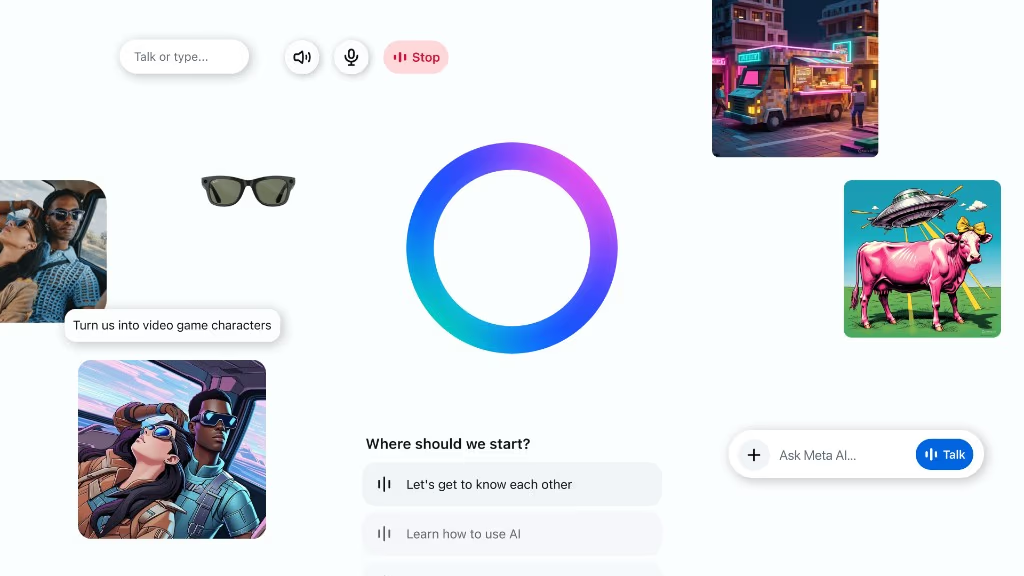
The central idea is simple: instead of switching to a separate app like ChatGPT, Meta AI is already inside the apps you open every day. You can ask it questions in a WhatsApp chat, use it to find content on Instagram, generate images in Messenger, or wear it on your face through Ray-Ban smart glasses.
If you need background on AI concepts first, see our guides to what artificial intelligence is and what generative AI is.
The model behind it: Llama 4
Meta AI is powered by Llama 4, Meta’s fourth generation of open-source large language models, released in April 2025. Understanding a few things about Llama 4 helps explain what Meta AI can and cannot do.
Three models, one name
The Llama 4 family released three models: Scout, Maverick, and Behemoth. Scout and Maverick are publicly available; Behemoth was still in training at release.
- Llama 4 Scout: 17 billion active parameters, 16 experts, 109 billion total parameters. Context window of 10 million tokens – one of the largest available in any model.
- Llama 4 Maverick: 17 billion active parameters, 128 experts, 400 billion total parameters. Context window of 1 million tokens.
- Llama 4 Behemoth: Over 2 trillion total parameters (288 billion active), described as the largest publicly disclosed AI model at the time of announcement.
All three use a mixture-of-experts (MoE) architecture – meaning only a subset of parameters activates per query, which reduces compute cost and latency relative to dense models of the same total size. They are natively multimodal: trained to process text, images, and video together rather than treating each modality separately.
Open-source access
Llama 4 Scout and Maverick are openly available on Llama.com and through partners like Hugging Face. Companies with fewer than 700 million monthly active users can use the models free of charge under Meta’s open-source license. This is a deliberate strategic position: Meta builds revenue through advertising on its platforms, so making the underlying models broadly available costs Meta relatively little and accelerates adoption.
Meta AI in WhatsApp
WhatsApp accounts for approximately 63% of all Meta AI interactions – the largest share of any single platform. This makes sense: WhatsApp has over 2 billion users globally, most of whom already open it multiple times a day. Meta AI in WhatsApp does not require a separate account or download.
How to access it
Meta AI appears in two places in WhatsApp. First, there is a dedicated chat thread with Meta AI in your conversations list – tap it to start a text conversation. Second, the search bar at the top of the chat list lets you type a question directly and get an answer without opening a separate chat. You can also @mention Meta AI inside a group chat to bring it into a conversation you are already having.
What you can actually do
- Ask questions: Current events, sports scores, restaurant recommendations, travel tips, how-to explanations – standard conversational AI tasks.
- Generate images: Type “Imagine [description]” and Meta AI creates an image you can share or save. The image appears in the chat with a preview and creation animation.
- Edit photos: Send a photo and ask Meta AI to add, remove, or change elements in it. For example, change the background, swap colors, or remove a specific object.
- Create AI stickers: Generate custom stickers based on text descriptions to use in chats.
- Voice responses: Press the waveform button to speak your question and receive a spoken response. Multiple voice options are available, including voices modeled on public figures who have partnered with Meta.
- Identify objects from photos: Send a photo and ask what something is – useful for translating a menu in a foreign language, identifying a plant, or getting context about an unfamiliar place.
Business use
Businesses using the WhatsApp Business app can deploy their own AI assistants for customer service, order tracking, and support, separate from the general Meta AI assistant. This is a distinct product from the consumer Meta AI experience.
Privacy note
Meta AI conversations in WhatsApp are not end-to-end encrypted in the same way your normal WhatsApp messages are. Meta can see and use these conversations. This is important to consider before sharing sensitive personal information with the assistant.
Meta AI in Instagram
On Instagram, Meta AI integrates into the places you already spend time: the search bar and direct messages.
AI-powered search
Tapping the Instagram search bar surfaces an “Ask Meta AI” option. Instead of keyword-based search, you can describe what you are looking for in natural language. For example: “Beautiful Maui sunset Reels” or “trending content about summer fashion” – and the AI returns curated results rather than a raw keyword match. Results are personalized based on accounts you follow, posts you like, and content you have interacted with.
This is a meaningful change from traditional search because it closes the gap between what people actually think (“show me something inspiring for a beach trip”) and what keyword search requires (“travel reels beach”).
DMs and group chats
Meta AI is available in Instagram DMs: you can start a dedicated AI chat thread, or @mention Meta AI inside any existing 1:1 or group conversation. From there it works similarly to the WhatsApp experience: questions, image generation, caption ideas, and general assistance.
Caption and content writing
A feature called “Write with Meta AI” surfaces when you are composing a post or a comment. It offers caption ideas, tone rewrites, and variations – useful for creators who need to post consistently and want a starting point rather than a blank page.
Image generation
As in WhatsApp, you can generate images inside Instagram DMs using text prompts. Generated images can be shared directly to Stories or sent to friends.
Meta AI in Facebook and Messenger
Facebook and Messenger were the earliest Meta platforms to receive Meta AI integrations. The assistant works through the search bar, comment replies, and dedicated chat threads in both apps.
Support assistant
In March 2026, Meta extended Meta AI to cover a specific and practical use case: account support. The AI support assistant on Facebook and Instagram can:
- Help report scams or impersonation accounts
- Explain why content was removed and guide users through appeals
- Help manage privacy settings
- Reset passwords and update profile settings
- Assist with login problems (rolling out in the US and Canada)
Meta states that requests are typically processed in under five seconds. This is available globally on iOS, Android, and desktop, and represents a shift from AI as a creative assistant to AI as operational infrastructure for customer support at scale.
Cross-platform memory
One feature worth noting: Meta AI supports cross-platform conversation continuity. You can start a conversation in WhatsApp and pick it up on Instagram or Facebook. This works because all the platforms share the same underlying AI infrastructure and (when permitted) user identity. Conversation memory persists for 30 days on the free tier, and 90 days on the paid AI+ tier.
Meta AI in Ray-Ban smart glasses
The most distinctive – and arguably most ambitious – Meta AI experience is in the Ray-Ban Meta smart glasses: sunglasses with built-in cameras, microphones, open-ear speakers, and Meta AI. These represent a different category of AI interaction entirely: hands-free, eyes-forward, always with you.
Hardware options (as of 2026)
Meta has expanded the Ray-Ban lineup across price points:
- Ray-Ban Meta Display: Released September 2025 at $799. Includes a full-color in-lens display and a Neural Band wristband that reads subtle hand movements (EMG) for control without touching the glasses.
- Ray-Ban Blayzer and Scriber: Launched March 2026 at $499. Designed specifically for prescription wearers, with flexible hinges and adjustable temple tips that work with nearly all prescriptions.
What the AI does on the glasses
The glasses use multimodal AI that combines what the built-in camera sees with what you say out loud. Practical capabilities include:
- Visual identification: Ask “Hey Meta, what building is that?” or “What kind of flower is this?” – the glasses use the camera and AI to identify landmarks, plants, animals, and objects in your field of view.
- Real-time translation: Point the camera at text in another language (a sign, a menu, a label) and ask Meta AI to translate it. The response comes through the speakers.
- WhatsApp summaries: Get hands-free summaries of your WhatsApp messages processed on-device with end-to-end encryption – so you can catch up on messages while walking or driving.
- Nutrition tracking: Look at a meal and say “Hey Meta, log this” – the AI extracts nutritional details from what the camera sees and adds it to a food log with insights over time.
- Spotify integration: Say “Hey Meta, play a song to match this view” and the glasses suggest Spotify tracks based on what the camera is currently looking at.
- Conversation Focus: Added in a December 2025 software update, this feature amplifies voices in noisy environments – the AI boosts conversational audio through the speakers so you can hear people more clearly in busy places.
Neural handwriting (Display model)
The Meta Ray-Ban Display includes a feature called Neural Handwriting: write on any surface with your finger and the glasses transcribe it into a reply to iMessage or other messaging apps. This is still an emerging interaction model, but it demonstrates how the glasses are designed to reduce phone reliance entirely.
What it still cannot do
The glasses do not yet overlay persistent information in your visual field the way augmented reality headsets do. The Display model adds a basic heads-up display, but it is not AR in the full sense. Battery life, bulk, and social comfort in public remain practical constraints for everyday wear.
Meta AI at meta.ai
Meta AI is also available as a standalone web experience at meta.ai. This functions similarly to ChatGPT or Gemini’s web interfaces: a clean chat window where you can have extended conversations, generate images, and work through tasks without being inside a specific social app.
The web version supports the same Llama 4 models as the in-app experience. For users who prefer a focused AI interface without the social context of Facebook or Instagram, this is the cleaner option. It also supports voice conversation – you can speak to Meta AI and receive a spoken response, with multiple voice options available.
Pricing: free vs. AI+
Meta AI is free to use across all platforms with no account required for basic features. The funding model is advertising: Meta monetizes through the platforms that host the AI, not through the AI itself at the base tier.
| Tier | Price | Key differences |
|---|---|---|
| Meta AI (free) | Free (ad-supported) | Full conversational AI, image generation, in-app integrations. 30-day conversation memory. |
| Meta AI+ (paid) | $10/month | No ads, 90-day conversation memory, expanded capabilities. Confirm current feature set on meta.ai. |
The AI+ subscription is relatively new and the feature set continues to evolve. The free tier is genuinely capable for most everyday tasks – the paid upgrade is primarily for users who want ad-free use and longer memory persistence.
Limitations to know before relying on it
Meta AI is broadly capable, but there are constraints worth understanding before treating it as an authoritative source or a production tool.
-
Not private by default
Meta AI conversations are not end-to-end encrypted. Meta processes them to improve the AI and may use them for ad targeting. Do not share sensitive personal, financial, or medical information in Meta AI chats.
-
Hallucinations
Like all current large language models, Meta AI can generate confident-sounding but incorrect statements. Verify anything factual – dates, statistics, medical information, legal details – through primary sources before acting on it.
-
Geographic availability
Some features – including voice responses and certain language capabilities – are rolling out in phases and may not be available in all countries. The AI-powered search in Instagram and some WhatsApp features were available first in the US, with gradual international rollout.
-
Image understanding is English-only
Llama 4 supports 12 languages for text, but image understanding – the visual AI that powers photo analysis features – is currently limited to English prompts and descriptions.
-
Less suited for deep work
Meta AI is optimized for quick, in-context assistance within social apps – answering questions, generating images, summarizing content. For extended research, complex code generation, or multi-step reasoning tasks, tools like ChatGPT or Gemini currently offer more focused interfaces and more powerful paid tiers.
How Meta AI compares to ChatGPT and Gemini
The three dominant free AI assistants in 2025-2026 are Meta AI, ChatGPT (OpenAI), and Gemini (Google). Each has a different core advantage.
Where Meta AI wins
Distribution. Meta AI reached 1 billion monthly active users by doubling from 500 million in just eight months (September 2024 to May 2025). This growth comes almost entirely from existing Meta app users – not from people deliberately choosing an AI tool. If you already use WhatsApp, Instagram, or Facebook, Meta AI is already there. No sign-up, no separate app.
Social context. Because Meta AI lives inside social apps, it has context that standalone AI tools lack: it knows which accounts you follow on Instagram, which topics appear in your feed, who is in your group chats. This makes it more useful for social-specific tasks like content discovery and caption writing.
Hardware integration. No competitor offers a comparable camera-equipped wearable with AI integration at scale. Ray-Ban Meta glasses give Meta AI a physical presence in the world that phone-based AI tools cannot replicate.
Where ChatGPT and Gemini have an edge
ChatGPT’s paid tiers offer more powerful reasoning models and a more polished interface for focused, extended work – document analysis, coding, long-form writing. Gemini’s integration with Google Search and Google Workspace (Docs, Sheets, Gmail) gives it an advantage for research tasks and for users embedded in the Google ecosystem. Neither requires accepting Meta’s advertising model to access useful features.
The honest framing
Meta AI is the right tool when you are already in WhatsApp or Instagram and need a quick answer, an image, or some help writing something. It is not trying to replace a full-featured AI platform. The Ray-Ban glasses are the most differentiated part of the offering – no other major AI company has comparable real-world hardware at a comparable price and scale.
Frequently asked questions
What is Meta AI?
Meta AI is the AI assistant built by Meta – the company behind WhatsApp, Instagram, Facebook, and Messenger. It is embedded in all of Meta’s apps and available as a standalone chat experience at meta.ai. It can answer questions, generate images, help with writing, and (via Ray-Ban smart glasses) interact with the world through a camera. It is powered by Meta’s own Llama 4 models and is free to use at the base tier.
How do I use Meta AI in WhatsApp?
You can access Meta AI in WhatsApp in three ways: tap the search bar at the top of your chat list and type a question; open the dedicated Meta AI chat thread in your conversations; or type @Meta AI inside any group chat to bring the assistant into that conversation. You can ask questions, generate images, send photos for analysis, or use voice mode.
Is Meta AI free?
Yes. Meta AI is free to use across WhatsApp, Instagram, Facebook, Messenger, and at meta.ai. The free tier is ad-supported and includes conversational AI, image generation, voice responses, and in-app integrations with 30-day conversation memory. A paid AI+ tier is available at $10/month, which removes ads and extends conversation memory to 90 days.
What can Meta AI do on Instagram?
On Instagram, Meta AI powers the search bar with natural-language search so you can describe what you are looking for rather than entering keywords. In DMs, it can answer questions, generate images, and help write captions. The “Write with Meta AI” feature offers caption ideas and tone rewrites when you are composing a post. You can access it through the search bar or by @mentioning Meta AI in any DM thread.
What can the Ray-Ban Meta smart glasses do with AI?
The Ray-Ban Meta glasses use the built-in camera and a multimodal AI to identify objects, landmarks, and text in your field of view. You can ask “what is that?” about something you are looking at, translate text in foreign languages, get hands-free WhatsApp message summaries, ask Spotify to play music that matches your surroundings, and track meals via photo. The glasses start at $499 for prescription-compatible models and $799 for the Display model with an in-lens screen.
Are Meta AI conversations private?
No. Meta AI conversations are not end-to-end encrypted in the way standard WhatsApp messages are. Meta can process these conversations. The exception is certain on-device features on the Ray-Ban glasses (like WhatsApp message summaries), which Meta says are processed locally. Avoid sharing sensitive personal, financial, or medical information in Meta AI chats.
How many people use Meta AI?
Meta AI reached 1 billion monthly active users as of May 2025, according to CEO Mark Zuckerberg. This makes it one of the most widely used AI assistants in the world. Approximately 63% of those interactions happen on WhatsApp, which accounts for roughly 630 million monthly active users of the AI feature alone.
Sources and further reading
- CNBC, Mark Zuckerberg says Meta AI has 1 billion monthly active users (May 2025): cnbc.com
- TechCrunch, Meta releases Llama 4 (April 2025): techcrunch.com
- Meta, Meta Ray-Ban Display: Breakthrough AI Glasses Available Now (September 2025): meta.com/blog
- Meta, Updates to Meta AI Glasses: Conversation Focus, Spotify Integration (December 2025): about.fb.com
- TechCrunch, Meta launches two new Ray-Ban glasses for prescription wearers (March 2026): techcrunch.com
- Meta, Boosting Your Support and Safety on Meta’s Apps With AI (March 2026): about.fb.com
- WhatsApp Blog, Talk to Meta AI on WhatsApp: blog.whatsapp.com
- Engineering at Meta, Building multimodal AI for Ray-Ban Meta glasses (March 2025): engineering.fb.com
- Meta Llama, Llama 4 model specs: llama.meta.com