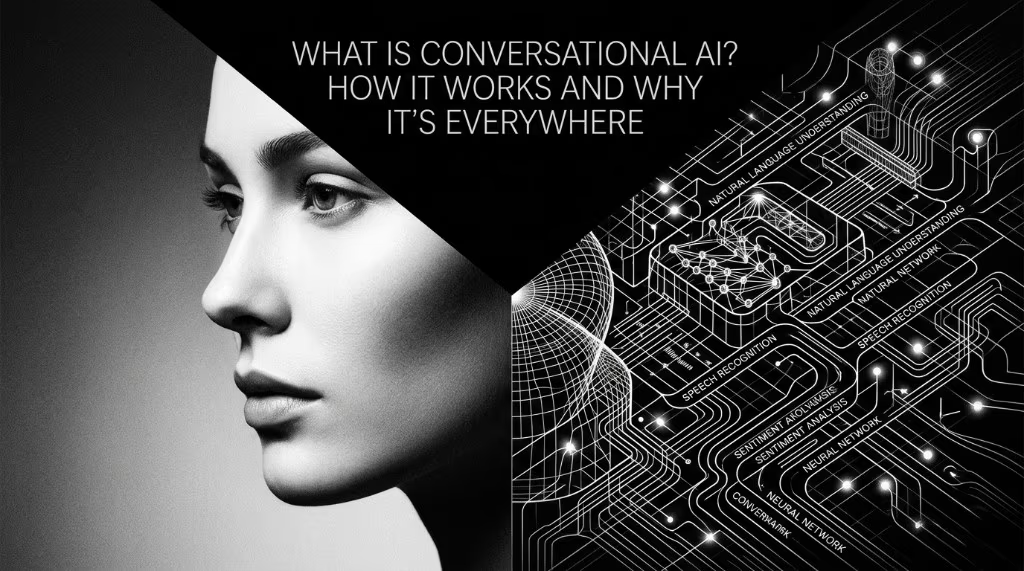
What is conversational AI?
Conversational AI is technology that lets people talk with software using natural language—by text or voice—and still get useful, context-aware answers and actions. IBM describes conversational AI as technologies such as chatbots or virtual agents that users can talk to, using machine learning and natural language processing to help imitate human interaction and interpret both speech and text inputs.
If you want the big picture first, start with:
Conversational AI vs chatbot vs voicebot (clear differences)
People often use these terms interchangeably, but they describe different layers of the stack.
Chatbot
A chatbot is a bot that talks in a chat interface (website chat, in-app chat, Messenger, WhatsApp, etc.). Some chatbots are simple rule-based FAQ flows. Others use NLU or large language models (LLMs). In other words, “chatbot” describes the interface and channel, not the intelligence level.
Voicebot
A voicebot is a bot that talks over voice (phone/IVR, voice in an app, smart devices). In addition to language understanding and dialogue, voicebots typically require:
- ASR (Automatic Speech Recognition): speech → text
- TTS (Text-to-Speech): text → speech
RFC 4313 (IETF) describes ASR and TTS as core speech processing functions in distributed systems.
Conversational AI
Conversational AI is the capability layer: understanding language, managing multi-turn conversation, keeping context, and (in practical deployments) integrating with tools and data so the conversation can do real work, not just talk.
How conversational AI works (without the math)
A modern conversational AI system usually looks like a pipeline. IBM breaks the core NLP flow into stages including input, analysis, dialogue management, and learning over time. In practical products, you’ll see the same idea implemented with different names.
-
Input (text or voice): the user writes a message or speaks.
-
(If voice) ASR: speech is transcribed into text.
-
Understanding: the system determines intent, entities/slots, and context—using NLU and/or LLMs.
-
Dialogue management: the system decides the next step: ask a follow-up question, confirm, call an API, or hand off to a human.
-
Tools & data (fulfillment): it fetches order status, schedules an appointment, creates a ticket, or retrieves knowledge (often via RAG).
-
Response (text or TTS): it generates the response and, if needed, converts it to speech.
Vendor platforms map to these same building blocks. For example, Amazon Lex describes building voice and text conversational interfaces with automatic speech recognition and language understanding, plus integration with AWS Lambda to invoke back-end business logic. Google’s Dialogflow CX describes flow-based agents for explicit conversation control across web, mobile, devices, and IVR with text/audio inputs and text/synthetic speech outputs.
Why it’s everywhere
Conversational AI spread because it matches how people prefer to get help: ask a question in plain language and get an answer immediately. It also maps cleanly to business outcomes, especially customer support and self-service.
- Faster customer support: handle repetitive questions (shipping, password reset, basic troubleshooting) 24/7.
- Better routing: classify intent and pass the right context to a human agent when needed.
- Action, not just answers: connect to real systems so the assistant can complete tasks.
Market reports vary, but the overall direction is consistent: adoption is growing rapidly. A Grand View Research press release cited projections of the conversational AI market reaching USD 41.39B by 2030 with a 23.7% CAGR (2025–2030).
Real-world examples (what it looks like in practice)
The easiest way to recognize conversational AI is to look for multi-turn context and system actions—not just a one-off answer.
E-commerce: “Where is my order?”
A good assistant asks for the order number (or email), calls an order/tracking API, and returns a concrete status and ETA. If the data is missing or sensitive, it asks follow-ups or transfers to an agent.
Banking/fintech: card lock, transaction lookup
For high-risk actions, a bot must authenticate the user, limit PII exposure, and confirm intent before executing changes. When confidence is low, it should escalate.
Telecom: outage troubleshooting and ticket creation
Voicebots are common here: the assistant gathers location and symptoms, runs a few checks, and creates a support ticket with the conversation summary.
SaaS support: agent assist
Conversational AI can draft replies, summarize a customer’s issue, and suggest next actions to a support agent—while the agent remains the final reviewer.
Benefits (and risks you should not ignore)
Conversational AI can be a cost-efficient way to scale support and standardize answers, but the downside is real when it’s deployed carelessly.
Benefits
- 24/7 self-service for common questions.
- Lower wait times and better triage.
- Consistent answers across channels.
- Scales faster than hiring and training.
Risks
- Wrong actions: misunderstanding intent can lead to incorrect account changes or misinformation.
- Hallucinations: LLM-based systems can produce confident but incorrect statements without strong grounding and constraints.
- Privacy and security: conversations can include sensitive data; logging and access controls must be designed carefully.
- Bad handoffs: if escalation paths are missing, users get trapped in loops.
Implementation checklist (quick but practical)
If you’re building or buying conversational AI, this checklist helps avoid the most common failures.
- Start with top FAQs: pick 20–50 high-volume intents and ship them well before expanding.
- Define “handoff” rules: when to transfer to humans (low confidence, sensitive actions, user frustration).
- Measure the right KPIs: containment rate, escalation rate, CSAT, latency, fallback rate.
- Ground answers: use a maintained knowledge base and retrieval (RAG) for policy and product facts.
- Protect data: redact PII in logs, enforce auth for sensitive workflows, keep audit trails.
Frequently asked questions
What is conversational AI?
Conversational AI is technology that enables natural language conversations with software via text or voice, using components like NLP, machine learning, and (for voice) ASR and TTS to understand input, manage dialogue, and generate responses.
Is conversational AI the same as a chatbot?
Not exactly. A chatbot is the chat interface experience. Conversational AI is the underlying capability (understanding, multi-turn context, and often tool/data integration). Some chatbots are rule-based and not very “AI” at all.
What’s the difference between a voicebot and an IVR?
Traditional IVR is menu-driven (“press 1, press 2”). Voicebots let users speak naturally and use ASR + language understanding to route and complete tasks, often with multi-turn context.
Where is conversational AI used most often?
Customer support and contact centers are common because the ROI is measurable: resolving repetitive questions, improving routing, and supporting agents with summaries and suggestions.
How do you keep conversational AI from giving wrong answers?
Use grounded knowledge (a maintained knowledge base plus retrieval), define guardrails, require authentication for sensitive actions, and build reliable handoffs to humans when confidence is low.
Sources and further reading
- IBM, What is conversational AI?: ibm.com/topics/conversational-ai
- AWS, Amazon Lex features: aws.amazon.com/lex/features
- Google Cloud, Dialogflow CX documentation: cloud.google.com/dialogflow/cx/docs
- IETF, RFC 4313 (ASR/TTS terminology and context): tools.ietf.org/html/rfc4313
- PRNewswire (Grand View Research), Conversational AI market projection (May 2025): prnewswire.com/…/conversational-ai-market…